We’ve stockpiled a lot of insights by engaging with numerous user research teams to understand their unique challenges. And along this journey, we noticed a common theme: many organizations grapple with the concept of research repositories. They're not sure if they need one or how to choose the right one for their needs. At the same time, we’ve seen how much research teams can benefit from a repository and how it enhances their work.
That’s why we put together this comprehensive guide. It's designed to simplify and demystify, offering practical guidance that will assist you in navigating the world of research repositories.
In the upcoming pages, we'll explain what research repositories are, share some guidelines to help you figure out if you need one, and find the right one for you. Our ultimate goal is to enable you to reap the benefits of research repositories and master the art of knowledge management.
Let this guide be your go-to resource as you explore the landscape and possibilities of research repositories. We hope you enjoy it and find it useful!
In our experience, researchers rarely wake up thinking, 'I need a research repository.' Instead, the need for a repository often becomes apparent in the course of everyday work.
Below are some common situations that indicate a research repository would make your life easier:
"I’m trying to connect my new insights to existing findings, but it’s really hard to do cross-study analysis."
"When a researcher leaves our organization all the knowledge leaves with them."
"We all analyze and report our research results differently, which leads to a lack of consistency."
"When a stakeholder asks for research insights on on a certain topic, it takes me a lot of time and effort to retrieve it."
"Research studies are replicated in our organization because it's hard to know what already exists."
"In one research session, I found useful evidence for another researcher, but I had no way to save it for them to use later."
In other words, organizations struggle with:
No Single Source of Truth: Research is scattered all over the place, with no central place to go.
Lack of Consistency: A unified, structured, and standardized research approach is missing.
Disconnected Research: Difficulty in cross-study analysis and bridging the gap between past research findings and new insights.
Underutilized Research: Research reports remain unread and data gets lost.
Duplication: Research is repeated multiple times.
Knowledge Drain: Valuable insights are lost as researchers change jobs and their knowledge leaves with them.
What Is a Research Repository?
If these previously highlighted challenges resonate with you, it’s a strong indicator that a research repository could be a valuable long-term asset for your organization. But let’s start with the basics and dive into the fundamental concept and significance of a research repository first.
We’ve closely engaged with researchers across various organizations, like Accenture, British Airways, HP, and more. As we learned more about their various needs, we came up with a unified definition of a 'User Research Repository'.
In essence, it is an easily accessible central place for your user research. It enables you to store, structure, and analyze data, bring together insights from various sources, and present a comprehensive user narrative. It also fosters cross-disciplinary and team collaboration, allowing researchers and stakeholders to actively participate and retrieve information.
User research repositories may also be called "Insights Repositories" or "User Insights Repositories." Sometimes, you may also come across terms such as "User Insights Knowledge Base", "UX Research Insights Database", or “Customer Insights Hub”. We’ll use the term “Research Repository" throughout this guide.
In short, a research repository serves as a comprehensive hub for all UX research-related needs, ultimately making your user research more accessible, actionable, and collaborative.
„Our research repository keeps a searchable archive of all our research sessions and findings. It speeds up the qualitative analysis process and simplifies the sharing of insights, ultimately leading to higher-quality findings. “
Tamara Oess
UX Researcher @ Yokoy
Elements of a Research Repository
Now that we've established a basic understanding of repositories, let's dive into the relevant elements. Typically, the content of a repository falls into two categories: Input and Output.*
The Input is what you import or configure in the repository for planning and conducting user research.
The Output is what you get from analyzing the input and often includes things like research findings and reports.
Although the design of a repository may vary depending on the scope and teams involved, there are recurring patterns that define the structure. Typically, we distinguish between key and added features, with the latter one not always being integral to a repository.
How it works: Encompasses the team's mission, vision, descriptions of the research methods, and tools and templates for consistent research.
Purpose: Clarifying team capabilities, expectations, and requests to promote shared best practices and a common research approach.
Research Projects
How it works: Organizes research activities into distinct projects, each with its own objectives, methods, and outcomes.
Purpose: Making it easy to manage different research initiatives, and find or revisit specific studies using relevant metadata.
Data and Insights
How it works: Stores raw user research data in an organized format, making it easier to analyze and synthesize insights.
Purpose: Preserving the original data collected during studies so that it’s easy to find and use for in-depth analysis when needed.
Research Storage and Sharing
How it works: Compiles and presents the findings, insights, and conclusions from research projects in a clear and organized manner.
Purpose: Enhancing research accessibility, making it easier to share insights and promote collaboration among stakeholders.
Added Features
Data Analysis
How it works: Supports tasks like transcribing, clustering, and tagging raw data. Allowing for easy search and insights retrieval.
Purpose: Helping researchers extract meaningful insights by enabling efficient data organization, collaborative tagging, and insights generation.
Participant Database
How it works: Maintains a GDPR-compliant record of research participants: demographics, consent forms, and contact information.
Purpose: Facilitating participant recruitment, managing consent and communication, and ensuring ethical research practices.
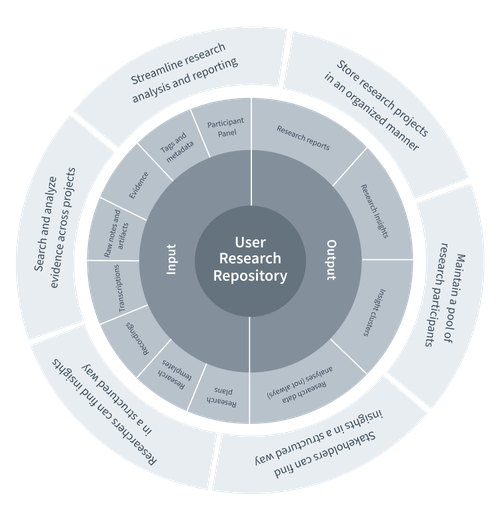
The scope of a research repository is strongly tied to your goals, as outlined in the framework below. This framework highlights the key input and output repository elements, along with its core objectives. Once your goals are clearly defined, leverage this framework to fine-tune your scope and select relevant repository components for your research. You don't need to include them all simultaneously, but each contributes to achieving your objectives.
Key Elements of a Research Repository Aligned with Objectives
Navigate Your Research Process with a Repository
The various components of a research repository smoothly integrate into the user research process. Whether it's research planning, recruiting, or synthesis, the repository improves the efficiency of researchers by streamlining tasks throughout the entire process.
Overview of the User Research Process:
Creation of Research Plan: A research repository centralizes templates, best practices, and previous research projects, enabling researchers to efficiently create research plans by using existing knowledge and methods.
Recruiting of Participants: By maintaining a database of participants, contact information, and segments, a research repository can streamline recruitment, saving time and ensuring GDPR compliance across studies.
Collection of Research Data: Though data collection typically occurs outside of a repository, many repositories offer seamless integrations with tools such as Zoom. Storing raw data within a repository further enhances traceability.
Analysis of Results: Certain repository tools allow for the transcription, structuring, and tagging of research data, empowering researchers to apply standardized methods for analysis and drawing conclusions.
Synthesis of Results: A user research repository facilitates the identification of patterns and themes by providing a centralized space for researchers to access data analyses and findings from previous studies.
Sharing of Research Findings: A repository serves as a centralized hub for storing reports, insights, and presentations, streamlining the sharing process and ensuring that findings are easily accessible to stakeholders.
Goals of a Research Repository
Repositories can help you achieve a variety of goals depending on the specific needs of your organization. Drawing on our experience with various organizations, we've pinpointed a few of the most common objectives:
Store research projects in an organized manner
Structure evidence consistently
Streamline research analysis and reporting
Make insights easy to find
Maintain a list of research participants
When you’re just getting started, we recommend identifying your top-priority goals. Select one or two key objectives, and progressively expand the scope of your repository to better support your research team or organization as a whole.
We highly encourage you to come back to this list as your organization grows so that you can reflect on the changes in your team structure. It’s important to regularly evaluate the requirements and feedback from your colleagues to identify additional functionalities.
On the next page, we’ll dive deeper into the goals outlined above.
Goals You Can Achieve with a Research Repository
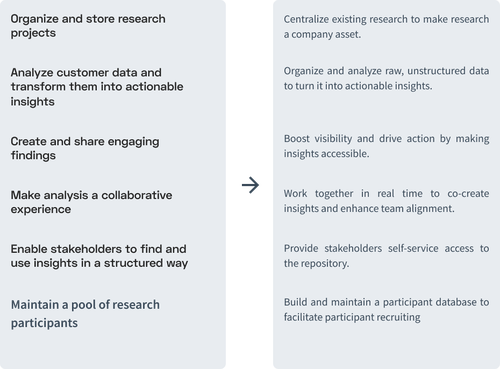
Organize and store research projects: Finding past projects easily and learning things faster improves the research process and provides better insights. Plus, research becomes a shared resource within a company, reducing reliance on a single person and preventing redundant research efforts.
Analyze customer data and transform them into actionable insights: Streamline your data workflow with automated transcription and translation, efficient tagging and categorization, and ready-made templates. Features like these will enhance your analysis process and help you go from raw data to findings easily.
Create and share engaging findings: For your research to make an impact, it needs to be seen by the right people at the right time. Make your insights impossible to ignore by creating visually stunning reports and video highlights that can be shared across communication tools.
Make analysis a collaborative experience: Make collaborating on research analysis both an easy and fun experience for your entire team. Make use of features like live note-taking and infinite whiteboards to host workshops and build stronger team alignment.
Enable stakeholders to find and use insights in a structured way: Research insights really only make an impact when they are seen and applied to informed decision making. So it’s important to make research as accessible and searchable to stakeholders as possible by empowering them with easy self-service access.
Maintain a pool of research participants: Some repositories allow you to store your panel of research participants and manage all their data in a central place. This helps facilitate recruitment, easily link research and participant data, and ensure strict compliance with research data privacy regulations.
Who Benefits from a Research Repository?
Whether you're a researcher, UX designer, product manager, or an executive, the benefits of a well-maintained user research repository extend across disciplines and practices.
From streamlining workflows to democratizing research, repositories are designed to make user research easier and insights more accessible for everyone involved in the process.
The core teams that benefit from a research repository are:
UX/Research teams
Product and Design teams
Other teams like Marketing, Sales, or Support
While all these parties derive value from a research repository, their utilization can vary according to their respective roles.
Typically, there are four scenarios of repository usage:
Researcher-exclusive analysis, archival, and search: The repository is exclusively used by researchers to store, organize, and analyze research data for informed decisions.
Researcher and stakeholder collaborative analysis: Both researchers and key stakeholders work together, encouraging cross-functional analysis of user research.
Selective sharing with product managers:
Distilled insights from specific findings are shared with product managers, providing crucial information to guide and inform the product development process.
Open repository access for everyone:
The repository is open to all employees, cultivating transparency and nurturing a culture centered around user engagement throughout the organization.
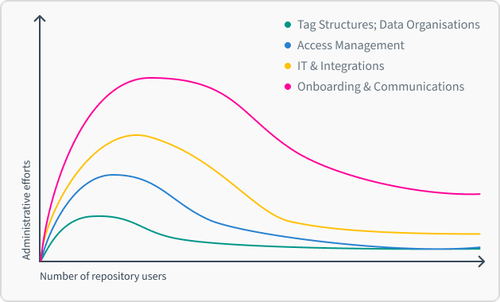
As a repository's user base grows, it brings forth new challenges associated with communication and maintenance:
Learning Curve: When people less familiar with UX research use the repository, it is likely that they will feel out of their depth and experience a learning curve.
Onboarding Complexity: When extending repository access to other teams, each new group requires separate administrative tasks and onboarding efforts. This can consume additional time and effort but is essential to maintain order and clarity.
Such Administrative Tasks for Managing a User Research Repository Might Involve:
Repository Configuration and Maintenance: With each new user group, it’s advised to reconfigure your repository’s access controls, revise its structure and organization, conduct regular data cleanup, and software updates.
Data Entry and Curation: As you collect more user research data, categorizing and maintaining its quality becomes more demanding.
Data Security and Backup: Ensuring the security of research data and implementing backup strategies becomes more critical as your repository grows.
Documentation and Metadata: Creating and maintaining documentation and metadata helps both new and existing users find and understand the stored data, which can become more intricate with a larger dataset.
Training and Support: As more team members or stakeholders use the repository, the onboarding training and support might be necessary to ensure effective usage.
As you can see in the graph, the initial setup and rapid growth take the most effort. Once the processes are set up, your repository works for your team with less admin work. Just remember, there's always some ongoing maintenance to do.
Starting small is a practical approach, and there's no need to be afraid of the process!
Deep Dive: Repository Adoption and Engagement
from our Guest-Author, Emily DiLeo
Why Is Adoption Important?
Adoption and value are inextricably linked when it comes to repositories. The greater the number of people who use your repository, the higher its value. And the more frequently people use your repository, the greater its impact! (Tip: for this reason, it’s important to track the usage of your repository)
Condens note: We also recommend adopting a mixed method approach to understand the impact of your repository. While tracking is beneficial, consider engaging stakeholders through regular check-ins to gather their feedback.
Understand the context of implementation: In order to formulate an adoption plan, you need to understand the context in which your repository is being introduced. And by “context”, I mean how people feel about it. Are folks excited about a repository? Skeptical? If you don’t know the answers to these questions, you need to find out!
Make adoption part of the planning phase: As you plan for your repository, you need to raise awareness about why your organization needs one. You should set up a communication strategy. And use the planning phase to identify people who have a desire to participate in the implementation of your repository.
You can touch on all of these by running a survey. Make sure it’s brief, and distributed to all of your stakeholders. Ask open questions, like “What value would a repository bring to our organization/company?” Questions like these will raise awareness and encourage people to think about how they might use a repository. I also like to include a question about concerns people have about a repository - this way I can respond right away and avoid pushback later on.
Build a network: There will be other people in your organization who care about knowledge management as much as you do! Don’t tackle this alone - identify those people and recruit them to help. Be clear about the time commitment and decide how you want the group to function. Do you need help with communication? Do you need working groups for things like taxonomy and user journey mapping? It’s extra helpful to have a variety of stakeholders in this group (e.g., product managers, and designers).
Engagement strategies: You may want to start a newsletter for your repository (or piggyback on another group’s comms). Reserve a few minutes in the team meetings of various stakeholder groups - you can present the initiative there and answer questions. Perhaps you run a highly visible pilot project, like gathering research from multiple teams on a particular product or topic. Whichever strategies you choose, the goal is to create visibility and engage colleagues on various levels. Know that some folks will be ready to contribute to the repository, and others will be less enthusiastic, so plan your approach carefully.
Beyond implementation: Plan for consistent adoption, as new employees come on board. Keep your comms solid, and provide support and a feedback mechanism for the repository. You will also want to track usage. Who uses the repository? What is their role? How often do they access the repository? What do they search for? And perhaps most importantly - what do users do with what they’ve found in the repository?
Give your repository a strong start and ensure success by creating a robust adoption and engagement strategy!
What Are Typical Pitfalls to Avoid When Introducing a Repository?
Introducing a new tool often comes with its fair share of challenges, and implementing a research repository is no exception. However, being aware of these challenges can significantly ease the entire process. That's precisely why we're here – to guide you away from common pitfalls and make your journey smoother.
By proactively tackling the issues below, you can greatly enhance the likelihood of your repository's success.
Possible Challenges or Risks When Introducing a Research Repository
Disorganization: Poor management and lack of a tagging structure (taxonomy) can cause clutter.
Underutilization: Teams might not fully use the repository’s functionality without proper adoption and integration.
Technical Challenges: Integration, migration, and compatibility can pose technical hurdles.
Adoption Resistance: Some teams might resist change and not adopt the new tool.
Maintenance Issues: Without regular updates, outdated or inaccurate data could mislead.
3 Takeaways When Considering a Research Repository
Now that you know the basics of user research repositories, here are three important points to remember before we move on to choosing one.
#1 Research Repositories Can Cater to Any Research Setting
A repository can be as small as just for one person using it to keep things organized. But as more people contribute and use it, there's the need for more building and maintenance. Don't be afraid to start a repository - you can begin small and add more components later. Think of it as taking small steps to unlock new features later. Also, think about the nature of your research projects so that you can implement a repository at the right time.
#2 Research Repositories Bring Maximum Value for Long-term or Collaborative Research Projects
Long-term research: For projects with extended timelines, a research repository provides a central hub to store and track evolving data, findings, and insights. If you're working on a short project alone, simpler ways of organizing your data could be enough.
Collaborative projects: When multiple researchers are engaged in a joint project, a research repository fosters synergy and collective knowledge management. However, if your organization doesn't do research very often, you might not need a repository right away.
It's a good idea to think about how much research you do before deciding if you need a repository.
#3 Involve Stakeholders as Early as Possible in the Decision and Implementation Process
When working within a team or organization, it's highly advisable to involve others early in the process of implementing a research repository. Start by discussing current information gathering practices and collaboratively exploring methods for sharing research findings.
By systematically addressing these considerations, you can ensure alignment with your team's needs and goals. Remember, success in implementing your research repository relies on taking incremental steps and engaging the right stakeholders at the right time.
We’ve now provided you with the core information you need to know about user research repositories, from what exactly a repository is to helping you determine if it’s the right tool for your user research efforts. As you move forward, you can anticipate information on what a research repository has in store for you and how it can positively impact your user research.
„Before we introduced Condens, our knowledge from UX research studies was distributed in different SharePoints, files, and platforms. Now we finally have one single source of information.“
Liesa Breitmoser
Team Lead UX Researcher @ ZEISS
How to Choose a Research Repository?
It’s time to take action! Your organization has made the important decision to introduce a research repository. What’s next? Preparation is the key to making this decision a success.
This chapter serves as your practical roadmap for selecting the right user research repository to meet your needs. We have gathered all the essential considerations you need to make to get your repository up and running. Starting from the definition of your goals to making the final decision and crafting an onboarding plan.
Here’s an Overview of the Evaluation Process:
Define your objectives
Assess the needs of your team
Specify features and functions
Narrow down your tool choices
Use demos and trials
Decide on and craft an onboarding plan
While we generally advocate following the six steps of the process sequentially, there may be instances where circling back to earlier steps is necessary. For instance, if you learn about an interesting feature of a repository during a demo (step 5) that hadn’t crossed your mind previously, you might consider incorporating it into your requirements list (step 3).
Maintaining some flexibility is advantageous in this regard. The duration of the evaluation process varies based on your organization's size and the number of people involved. It can take as little as a day for a one-person research team to make a decision, and several weeks for a large organization.
1. Define Your Objectives
Defining clear and concise goals is a fundamental step in the process of choosing a user research repository. This not only sets the stage for purposeful and efficient decision-making but also serves as a guide for defining the repository's scope, influencing considerations like onboarding, setup, and taxonomy.
The scope of a research repository is influenced by factors like the specificity or breadth of your research focus, the integration of methods or specialization, timeframe, geographic coverage, data types, and the duration of your objectives (long-term or short-term). These factors hinge on your team's resources and will help you identify the primary goals for the repository. Begin by reflecting on your primary objectives and the potential scope.
Use the examples below and choose the right focus for your repository implementation.
2. Assess Team Size, Audience, Needs and Practices
When choosing a research repository that perfectly suits your needs, it's crucial to evaluate factors like team size and target audience, and perform a thorough needs and current practices assessment.
This process should involve all team members who will use or contribute to the repository to facilitate its adoption.
First, consider the size of your team. Whether you are working in a small, agile group or a large, interdisciplinary team, understanding the dynamics and workflows within your organization will guide you towards a repository that can seamlessly accommodate your team's collaborative efforts.
Next, determine your target audience – those individuals who will actively engage with the repository. Are you primarily addressing fellow researchers, stakeholders, clients, or a combination of these groups? Acknowledging the diverse needs and preferences of your audience will lead you to a repository that enhances your user experience.
Performing a needs assessment is a crucial step in this process. Collaborate with your team to pinpoint the specific challenges and requirements they face while handling research data, documents, and findings. Identify the essential features and functionalities that are critical to your team's success, such as version control, data security, collaboration tools, and data visualization capabilities.
It’s also important to do some groundwork. Start by listing your current research tools, methods, and data setup. This helps you understand what you're currently using, what you need, and how much you're spending. Talk to your colleagues to learn more about their experiences with these tools. This is crucial for selecting a repository that matches your team's needs and fits within your budget.
3. Specify Features and Functions
Once you’ve defined your goals and have a list of your needs, you should have a better understanding of the functionalities and features that are essential for your organization. Try listing the ones you require.
Here’s a list of potential features you might need:
Organize and store research projects
Centralized repository for all customer data
Seamless data import with integrations and bulk upload options
A taxonomy for quick and easy data retrieval
Effortless sharing and export functionality
Standardized templates for projects, sessions, and reports
Analyze customer data and transform them into actionable insights
Tailored homepages for different stakeholder groups
Conversational AI search for finding insights easily
Read-only access for stakeholders to view research findings
Advanced access permissions to control insights visibility
Maintain a pool of research participants
GDPR, HIPPA, CCPA, and APA compliant participant database
Connect participant data to projects and findings
Anonymize participant names when sharing data
Easily delete personal data as needed
Search and filter research data by participant attributes
Once you've pinpointed the functions of a user research repository that best aligns with your team's goals and needs, it's time to search for a tool that offers those features. Let’s explore the various types of tools available in the market.
4. Narrow Down Your Tool Choices
It's now time to kick off the comparison of various tools and resources. During the process of refining your tool selection, you'll most likely encounter two fundamental questions:
Should I opt for a generic or specialized tool?
Should I use a single tool for both analysis and archiving?
4.1. Using a Generic Tool
The primary advantage of a general-purpose tool, such as Google Drive, Confluence, or Notion, is that typically, everyone within your organization already has access to it, which helps you avoid the “Yet another tool” hurdle. While using a generic research repository may seem convenient at first, there are also several drawbacks and limitations to consider when applying it to user research. Let's explore the pros and cons in more detail.
Generic research repositories can be useful for general research purposes but may not be the most optimal choice for managing user research data.
4.2. Using a Specialized Tool
Specialized user research repository platforms tend to offer superior features, organization, and collaboration capabilities, tailored to the unique demands of UX research. Specialized user research repository platforms offer many advantages but they also have some potential drawbacks to consider. Let’s take a look at both of them:
4.3. Using a Single Tool Versus Separate Tools for Data Analysis and Storage
Should you use a single tool for both data analysis and storage, or should you go with dedicated separate tools for these tasks? Let's dive into the pros and cons of these two options.
Different Tools for Data Analysis and Repository:
When researchers use different tools for data analysis and storage, they need to spend extra time and effort to make sure they document and save their findings properly. The additional effort needed for this archival task involves the following steps:
Gather all data from multiple sources and move it to the archive.
Organize the data in a way that makes sense (e.g. separating raw data, analysis, findings)
Add context for searchability (time of study, topics, involved researchers)
Combining Data Analysis and Storage into One Tool
When researchers use a single tool that combines data analysis and storage, they can save a lot of time and effort by analyzing the data and storing their findings all in one place. This makes it easier and more efficient to use the information and conduct cross-project analysis.
Let’s explore the benefits in more detail:
Easy Data Handling: The tool does the job of gathering and organizing data, so researchers don't have to do it themselves. Everything they need is in one place.
No More Missing Info: The tool automatically adds important details like when the study happened and who was involved. This helps researchers understand the context without having to do extra work.
Enhanced Searchability: Because the tool keeps data and its backstory together, it's easy to find what you need. You can search for specific information using i.e. keywords.
Save Time and Energy: Since you don't have to switch between different tools or spend time organizing data, you can focus on the important parts of your research.
Teamwork Made Simple: When everyone uses the same tool, it's much easier to work together. Multiple researchers can access and work on the same data without any hassle.
Your Research Stays Valuable: The tool keeps your research useful for a long time. You and your colleagues can always go back to it, even years later.
In a nutshell, using a tool that handles both data analysis and storage makes research a lot easier. It takes care of the tricky parts, so you can focus on what really matters.
Consider Different Needs of Different Stakeholders
When deliberating on the selection of analysis and repository tools, it's vital to take the diverse needs of all parties involved into account. In essence, we can categorize stakeholders into three primary groups:
Researchers: Usually the ones using a repository on a daily basis. So, they require robust tools for data collection, analysis, and organization to effectively support their research efforts.
PwDR - People who Do Research: Also actively involved in generating research data and insights. They need easy access to research data, efficient search capacities, and collaboration support to facilitate the research process.
Research Consumers: This broader group includes stakeholders who rely on research findings to make informed decisions, spanning across various departments within the organization. They mostly need access to organized, comprehensible, and up-to-date research data.
These two groups have different requirements, which are difficult to address in the same tool. So how can you balance the need for integration and separation?
A potential solution is to implement an analysis tool and a repository that shares a common database with customized interfaces for Researchers and Research Consumers.
The Mechanism of a Unified Data Analysis and Repository Tool
Database of User Research Data: Prevents misleading data by maintaining accuracy.
Analysis tool: Helps to uncover meaningful insights and guides informed design decisions.
Repository: Centralizes, organizes, and provides easy access to valuable insights.
Researchers will benefit from a dedicated tool to streamline their research and data management processes. At the same time, Research Consumers can enjoy a user-friendly and straightforward interface to access and comprehend research outcomes. This approach enables both groups to access the same information while customizing how they interact with the data to suit their specific needs.
Condens Integration: Condens provides the best of both worlds. The analysis tool and the repository share the same data foundation, ensuring that adding data to the repository is effortless.
After addressing the aforementioned questions, you should have a solid foundation for your tool selection process. To assess the quality, usability, and reliability of each option, leverage online reviews, ratings, and recommendations from fellow UX researchers. Furthermore, take into account the compatibility, integration capabilities, and scalability of these tools in relation to your existing systems and processes.
A good starting point could be this list of reviewed tools from G2. Begin with a long list and then refine it by examining your non-negotiable or critical criteria. Try to narrow your selection down to two or three vendors for a more thorough evaluation. This number strikes a balance between offering enough choices to find the best fit while respecting your time constraints.
Here are the top 5 reasons researchers choose Condens as their research repository tool.
Five Reasons Why Researchers Choose Condens Over Other Research Repository Tools
Easy Onboarding & Intuitive Usage: Condens prioritizes simplicity for both novices and seasoned users. Whether you're a newcomer to research or an expert, Condens ensures a low learning curve with its user-friendly design and intuitive structure. Newcomers will find guidance throughout the workflow, while seasoned researchers can capitalize on shortcuts and AI-assisted tagging for enhanced efficiency.
Instant Sharing of Insights: Sharing your research findings through Condens is as easy as a couple of clicks. No need for your stakeholders to create accounts - they simply open a link in their web browser. Meanwhile, you maintain full control of the shared reports, with options to unpublish, add passwords, or protect participant identities.
Insights Magazine with conversational AI search for stakeholders: Elevate the impact of your research by allowing stakeholders to explore it independently. Condens’ Insights Magazine is a space for your colleagues to search and explore research results, similar to a curated magazine. It focuses on research findings and ensuring privacy for sensitive data.
Live Collaboration Made Simple: Whether you're working remotely or in-person, Condens enables real-time collaboration. Work together simultaneously on documents, like taking live session notes or synthesizing data as a team. You can easily see where others are working and join in effortlessly.
Exceptional Personal Support for All Plans: No matter the size of your team or organization, Condens provides top-notch, personalized support and guidance. Reach out via email or schedule a video call. Our dedication to excellent service and a personal touch is what sets Condens apart!
5. Use Demos and Trials
Once you've narrowed down your tool options, it's time to gather more information and insights about each specific tool. We highly recommend utilizing free demos and trials to assess the user experience, interface, and functionality. Additionally, reaching out to the customer success team for valuable insights into how each tool can meet your needs and goals.
We also suggest going beyond testing the tool with sample data and conducting actual research projects on each platform. If using real data in a trial poses challenges, there's typically the alternative of employing dummy or example data. In any scenario, this approach allows you to thoroughly evaluate the workflow and determine if the tool is the right fit for your team. When assessing these tools, further consider the respective pricing, data privacy and security measures, the quality of customer support and the onboarding process.
To guide you through this evaluation process, we offer a template for selecting a UX research repository. This resource aids in identifying the most suitable tool for your needs and includes a vendor comparison overview.
Choosing the right research repository may present a challenge, but it's a manageable task, and we're here to assist you in simplifying the process. Use this checklist to make sure you won't overlook any essential factors when evaluating potential tool providers. Let's get started and make sure your research gets the recognition it deserves.
Create a shortlist of 2-3 vendors for your user research repository
Visit their websites and help centers to learn about their capabilities
Send them the evaluation spreadsheet with your goals to see what they can offer
Use the template's page two to assess user expereince and functionality, rating each tool from 1 to 5 and adding qualitative comments.
Evaluate security and privacy with involvement from your legal team.
Consider support and onboarding aspects, including available communication channels and time zone compatibility
If evaluating as a team, have team members individually fill out the evaluation template and discuss the results later.
Assess the pricing of each tool for your team.
Schedule personal demos with vendors and use free trials to better understand how the tools match your requirements.
If possible, use the tools with real research data to get a practical sense of their usability.
6. Decide on Your Tool and Craft an Onboarding Plan
After conducting demos and trials with potential tool providers, it's time to make a decision. Organize a meeting with your team and/or manager to thoroughly review the feedback you gathered and assess which tool aligns most closely with your specific requirements. Utilize the provided template and discuss the results.
When choosing a user research repository tool, consider all the factors that were discussed in the previous sections and further assess the ease of use, collaboration capabilities, security, and integration with the tools your team currently uses. Additionally, ensure that the tool aligns well with your organization's specific user research needs and workflows.
Once you've made your choice of a tool, designate a responsible individual to oversee its implementation. This includes not only the procurement process but also defining the data structures (e.g. taxonomy) within the repository, orchestrating the migration of existing research materials, granting access to all users, internal communication regarding the repository, and ensuring a seamless onboarding experience for everyone.
„Condens supports and streamlines the entire process from collecting evidence to sharing findings.“
Thomas Fortmann
Senior User Researcher @ Morressier
„With Artifacts and Structured Fields, I feel like Condens has the most important things I need to build a proper repo. Those bits give it real powers!! Well done!“
Ioana Giart
UX Research Team Lead @ Adverity
From Basics to Best Practices: Final Thoughts
That’s it! We hope this guide has equipped you with the knowledge and confidence needed to navigate the selection of your ideal research repository.
User research repositories are invaluable tools, enhancing your ability to leverage research insights effectively. Our aim was to simplify and demystify the concept of research repositories, and provide practical guidance for evaluating their relevance within your organization to help you make the right choice.
Let's recap some of the key aspects we've covered:
The essence of research repositories.
The key beneficiaries.
Three pivotal considerations when discussing these repositories.
A step-by-step guide on selecting the ideal repository for your specific needs.
As you continue your journey with repositories, we encourage you to put our best practices and helpful tips into action and fully harness the collaborative potential of user research repositories.
Above all, remember this: whether you're an independent researcher or part of a larger team, a repository is a flexible tool that can adapt to your changing needs and requirements. Armed with the insights from this guide, you're well-prepared to make informed decisions when it comes to research repositories.
About Condens
Condens is the central hub for all your customer knowledge. As both a research repository and analysis tool, Condens helps researchers, designers, and product teams bring together everything from interviews and usability tests to product feedback and surveys in one place.
Import raw data, auto-transcribe recordings, and let AI do the heavy lifting: summarizing sessions, surfacing patterns, clustering themes, and answering questions about your data in plain language, so you can spend more time on the work that actually requires your expertise.
Every AI-generated summary and highlight links back to the raw transcript it draws from, keeping findings traceable and credible without slowing you down. Connect insights across projects, build a searchable repository, and share findings via a dedicated Insights Magazine and let stakeholders search key findings directly from Slack or Teams, so research is front and center when decisions are made.
Ready to see it in action? Start your 15-day free trial today.
„The simplicity and clear UI make it very easy to get started and I was positively surprised by the level/speed of support. They guided us also to come up with a taxonomy that makes sense for us – free of charge! A big plus for us is also the flexible user management and the fact that the repository is accessible across the organization without payment.“
Lena is the Head of Marketing at Condens, where she leverages her expertise in B2B and SaaS marketing. With a proven track record in crafting effective strategies for tech startups, Lena is passionate about optimizing processes and gaining insights into user behavior. She believes that understanding user pain points, needs, and preferences is crucial for successful marketing. At Condens, she is eager to lead marketing initiatives and contribute valuable insights to the UX research community.
About the Author
Alex Knoll
Alex is the CEO and Co-founder of Condens. He started his career as a product manager, and interviewed more than 160 UX Researchers from around the world to identify pain points and find opportunities for improving research processes before founding Condens. He is particularly passionate about Research Ops, creating effective Product teams, and he often speaks at UX Research events.
About the Author
Anna Kukushkina
Anna is a Product Marketing Specialist at Condens. Coming from a B2B tech startup and having an academic background in consumer technology adoption behavior, she is passionate about driving software products and exploring how people use them. Anna contributes to the UX Research community with content in all formats from long-form articles or snackable social media takeaways to organizing in-depth user research talks, always focused on finding new angles and providing useful input.
Want to receive UX Research Meetup & Event guides, new content and other helpful resources directly to your inbox? Enter your email address below!