Guide: Drive Repository Adoption and Stakeholder Engagement
Learn how to choose the best approach to introducing your repository to stakeholders step-by-step and keep them engaged over the long term.


AI adoption is no longer the question in user research. Almost everyone is using it, most use it regularly, and the vast majority plan to increase their usage over the next year.
What’s far less settled is whether AI is actually improving research analysis in the ways practitioners hoped it would.
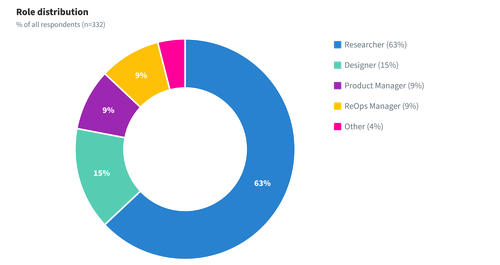
We ran a survey with 332 research practitioners (researchers, designers, Product Managers, and ReOps managers) to understand how AI is showing up in their analysis work.
AI is clearly delivering value, especially around speed and workload reduction. But those gains come with tradeoffs. Across the dataset, the same tension surfaced again and again: AI helps teams move faster, but trust lags behind. The people most likely to feel that gap are the ones doing the most hands-on analysis (researchers themselves), while roles further from the day-to-day often report significantly higher satisfaction.
This report walks through what we found, where the patterns are clearest, and where the data raises more questions than it answers. We'll cover where AI is winning, where it's falling short, why different roles report fundamentally different experiences, and what practitioners say would actually move the needle.
The survey collected 332 valid responses, heavily weighted toward people actively conducting research rather than simply consuming insights.
Researchers made up the largest group at 63%, followed by Designers (15%), Product Managers (9%), and ReOps professionals (9%). The remaining responses came from adjacent roles like UX Leads, Research Leads, and Heads of Design.
Company size was spread fairly evenly. Small companies (under 200 employees) made up 39% of the sample, mid-market (201 to 5,000) was 35%, and enterprise (over 5,000) was 26%. Tech and software led the industry breakdown at 39%, with consulting and agency at 15% and e-commerce and retail at 13%.
About three-quarters of respondents interact with research daily or weekly, so we're hearing from people who live in this work, not from people consuming finished reports. Researchers were the most likely to work with research every day, while Product Managers and ReOps professionals tended to engage on a weekly cadence. Designers sat somewhere in between, with research forming a more intermittent part of their workflow.
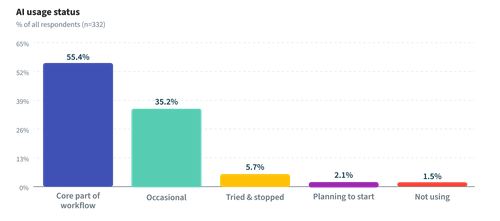
If you only looked at adoption numbers, AI in research analysis would appear almost fully mainstream. 91% of respondents are using AI in some form, and for 55%, it's a core part of their workflow. Of the remaining 9% not actively using AI, the most notable figure is how few stopped after trying: just 6%.
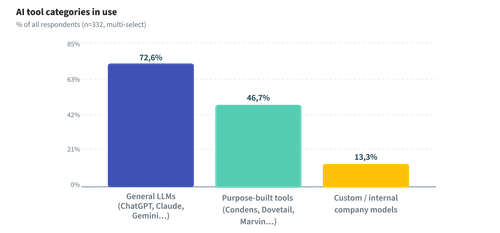
General-purpose LLMs dominate usage. 73% rely on tools like ChatGPT, Claude, or Gemini, compared to 47% using purpose-built research platforms like Condens. Many use both: nearly half combine a general LLM for open-ended tasks with a purpose-built tool for structured analysis.
That 26-point gap tells us something important: a substantial share of AI use in research is happening outside dedicated research tools.

Where is all this AI use actually paying off? Pretty clearly on speed.
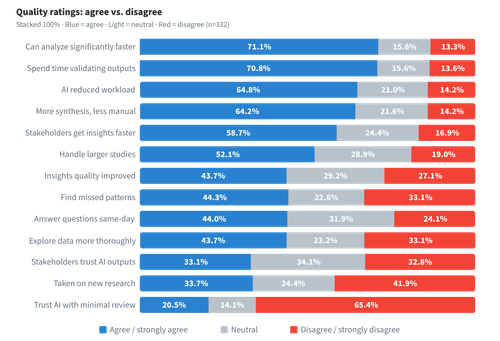
71% of respondents agree that AI lets them analyze data significantly faster. 65% say it has reduced their analysis workload. 64% say they spend more time on synthesis and less on manual tasks. 59% say stakeholders get insights faster than before. These are the four highest-agreement statements in the entire survey, and they're all about efficiency.
The tasks people are using AI to back this up. The top five tasks, all used by more than 81% of respondents, are answering specific questions about data, summarizing sessions, synthesizing insights, finding patterns, and clustering similar insights. Transcription sits just below at 79%, with searching past research at 77%.
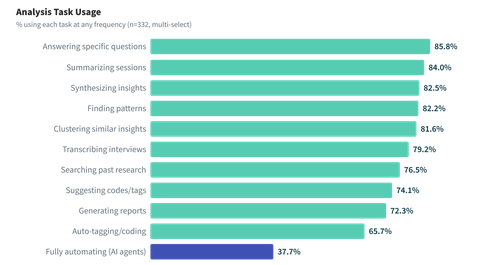
These are exactly the tasks that used to consume the most time in qualitative analysis, and AI is now handling at least a first pass on all of them.
One quote from the survey captures it well:
„For me, it has made the biggest impact in synthesizing a large amount of data. I recently had 60 think-out-loud sessions to get through, and what would have taken me probably over a week was done within a day. That aside, my mental health is better for it.“
That’s the optimistic read of the data. AI is removing a lot of the repetitive work from research and giving practitioners back hours that used to be spent on transcription, tagging, and surface-level pattern hunting.
But there's a ceiling to all this, and the survey makes it visible. Only 52% of respondents agree that AI helps them handle larger studies. That's the first statement to drop below a majority, and it serves as the bridge between the efficiency story (which is strong) and the quality story (which is much weaker). Speed and workload reduction are happening. Capacity is starting to follow. But once we get past mechanical tasks and into the actual judgment of "is this insight good," the agreement rate falls from 65% to 44%.
That's where we go next.
While speed is the clearest win, quality remains the clearest limitation.
The most common frustration in the entire survey was that AI-generated insights feel too generic or surface-level, selected by 52% of respondents. The second-most selected shortfall was "loses important context," at 42%.
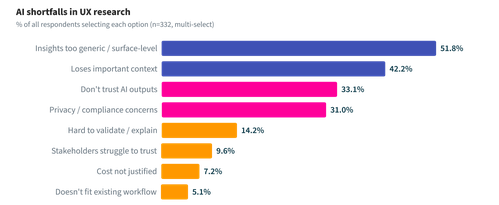
Together, these two describe the same problem from two angles. AI can summarize, cluster, and pattern-match, but it flattens nuance. It treats outlier comments as representative, glosses over insights mentioned by multiple participants, and reads words at face value without understanding what they meant in context.
The same pattern shows up in how practitioners rate AI's contribution to quality. Only 44% agree that AI has improved the quality of their insights, with 27% actively disagreeing. The same percentage (44%) agree it helps them explore data more thoroughly, with 33% disagreeing. 'Find patterns I would have missed manually' sits at 44% agree and 33% disagree. None of these statements crosses 50% agreement, while the four statements about speed and workload all land between 59% and 71%.
One respondent summarized the issue this way:
„It gives you a summary-like sweep, but it's often incredibly generic. It flattens peaks and lows to a general average. It also takes words at face value, lacks context.“
Others described the same thing in different words. AI over-indexes on outlier responses. It misses contributions from quieter participants. It hallucinates quotes that weren't there. It applies a tag to a snippet that, in context, means something completely different. It produces confident-sounding takeaways without disclaimers about the underlying uncertainty.
The hardest part, especially for qualitative work, is what AI can't see. AI still struggles with:
Non-verbal cues
Tone and emotional nuance
Contradictions between what participants say and do
Institutional or historical context
Interpreting behavior within the context of a prototype or interface
Again and again, respondents made the same point: the value of research lies between the lines, and AI is still working only with the lines themselves. AI is useful as support, but rarely as a replacement for human interpretation.
„It is like having a smart and fast intern that needs a lot of direction, feedback, and support.“
That framing came up repeatedly across the open responses:
AI as a junior.
AI as an assistant.
AI as an intern that still needs supervision.
That might be why most practitioners still hesitate to hand AI the parts of research that actually drive decisions, and why double-checking almost everything has become standard practice, which we'll look at next.
One of the most revealing findings in the survey was this:
71% of respondents agree AI lets them analyze data significantly faster.
71% also agree that validating AI outputs still takes significant time.
These two statements are almost perfect mirror images.
The picture they paint together is this: AI is clearly accelerating parts of the workflow, but much of the saved time is being reinvested into verification.
Trust numbers tell the same story from a different angle. Only 21% of respondents agree they can trust AI outputs with minimal review. That's the lowest agreement rate on any statement in the survey. The disagreement rate on the same statement is 65%, the highest in the dataset. Whatever AI is doing well, it has not earned the right to be left alone.
What does validation actually look like in practice? Practitioners are not leaving AI unattended.
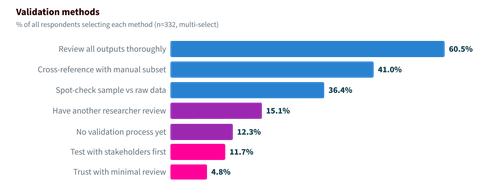
61% thoroughly review every AI-generated output.
41% cross-reference AI analysis against their own manual work.
36% spot-check outputs directly against raw data.
Only 5% trust AI with minimal review.
The open responses revealed more deliberate habits.
Asking AI questions they already know the answer to
Running the same analysis through multiple LLMs
Using one AI system to critique another system’s output
Rather than being lightweight workflows, these are compensating behaviors created because practitioners still do not fully trust the output. As one respondent explained:
„It is a huge time saver, but still produces a lot of hallucinations. Manually reviewing the data helps and gives some peace of mind, but anxiety about overlooking certain things still exists.“
There's also a smaller but meaningful problem hiding in these numbers. 12% of respondents say they haven't established a validation process at all. Given that 71% report spending significant time validating, that means a portion of practitioners are validating in unstructured, ad hoc ways without a defined approach. They feel the burden but don't have a system for it.
The preferred division of labor between AI and humans reflects all of this. When asked what role AI should play in analysis, 36% chose "AI analyzes and synthesizes, then I review and approve." Another 24% chose "AI suggests codes and patterns, then I do the synthesis myself." 20% chose "AI codes and identifies patterns, then I synthesize." Together, these three options account for 80% of respondents, and they all describe the same model: a supervised collaboration with a human in the loop. Only 5% want AI to do full end-to-end analysis. About 1% don't want AI involved at all.
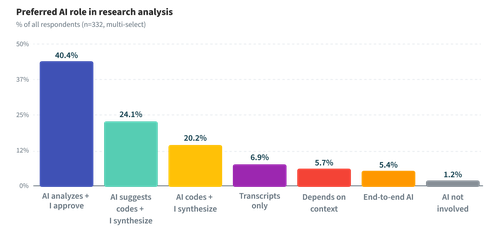
The collective answer is fairly clear. People want AI to do the work, and they want to be the ones to say whether the work is any good.
That gap between trust and verification is felt very differently depending on what role you play in the research process. That's what we'll look at next.
No divide in the survey was larger than the one between Product Managers and Researchers. On a 1-10 satisfaction scale, Product Managers reported a median satisfaction score of 9. Researchers reported a median of 6. Designers landed at 7, while ReOps professionals sat at 8.
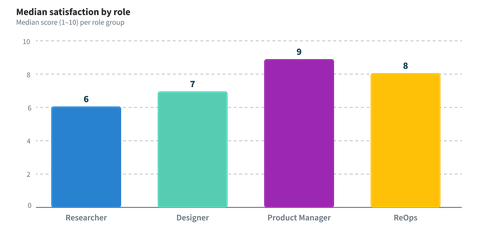
That three-point gap between Product Managers and Researchers is three times larger than any company size or usage depth difference in the dataset. How often someone interacts with research makes almost no difference to how satisfied they are with AI: daily practitioners and monthly ones report nearly identical scores. What does correlate is how deeply AI is embedded in their workflow: core users report higher satisfaction than occasional ones.
The split is not about exposure to AI. Both groups actively use it. The difference is what they expect from it.
Product Managers are using AI more, across more tasks, with more enthusiasm. They report a "core to workflow" usage rate of 68% (vs. 55% for everyone else on average). They use AI on 80 to 94% of the eleven tasks we asked about. They have by far the highest appetite for full end-to-end automation (16% of Product Managers vs. 3% of researchers want this). They trust AI outputs at a median of 4 on a 1 to 5 agreement scale. Only 32% of them say they review every output thoroughly, the lowest of any role. 22% say they trust AI with minimal review.
Researchers describe a different relationship. Their median satisfaction is 6. They distrust AI outputs at a median of 2. 68% say they review everything thoroughly. They prefer the most conservative AI roles in the workflow, and they're the only group with a notable share (8%) saying AI should only prepare transcripts and stay out of the rest.
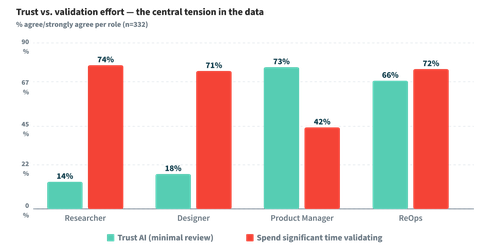
Why such a sharp divide? The data points to a clean answer. The two groups are asking AI to do different things and holding it to different standards.
Product Managers primarily use AI for synthesis, summarization, communication, and decision support. They typically interact with research weekly rather than daily. In many cases, they need a concise summary, a fast answer, or a draft they can refine and share.
Speed matters more than nuance in their workflow, and AI delivers on that. Their analysis pain points are correspondingly low. They report the lowest rate of "analysis feels repetitive or tedious" (19%) of any group, which tracks: they're using AI for the parts of analysis they were never going to enjoy anyway.
Researchers operate much closer to the raw material. They use AI on qualitative data they know intimately and need to defend. Researchers work directly with transcripts, participant behavior, edge cases, contradictions, and contextual nuance. They're the ones who notice when a quote has been pulled out of context, when an outlier has been over-weighted, when an idiom has been mistranslated.
And they are the ones who will be asked, when a stakeholder pushes back, to explain how this insight was reached. That last part matters. This is why researchers, when asked what would make AI more valuable, rank accuracy (65%) and transparency into conclusions (54%) at the top of their list. They want to be able to inspect and defend the work.
As one respondent put it:
„Research analysis is a skill, I don't want to lose it or lessen the capability. Analysis, synthesis, and insights need human thought and consideration for empathy building.“
That sentiment came up repeatedly in the researcher's responses. It wasn’t resistance to AI so much as a reminder that the real value of research comes from interpretation, nuance, and judgment.
Designers and ReOps professionals round out the picture. Designers’ biggest challenges were not primarily about speed. Instead, they struggled most with:
Referencing past research
Involving stakeholders in analysis
For Designers, AI often functions less as automation and more as a discovery and collaboration layer.
ReOps professionals approached AI differently again. Their responses leaned heavily toward operational efficiency and throughput. They showed the strongest preference for “AI analyzes, I approve” workflows and placed the least emphasis on needing transparency into how conclusions were generated.
Four roles. Four very different relationships with the same technology. The same features cannot serve all four with the same defaults.
It’s easy to reduce these results to “some roles embrace AI more than others,” but the data points to something more nuanced. Researcher skepticism is grounded in their day-to-day experience of where AI breaks. They are the people closest to where AI still breaks down. Their skepticism is expertise responding to a tool that hasn’t fully earned their trust yet.
That difference in experience shows up in how research itself flows through organizations.
There's a pattern that runs through several pieces of this data, and it's worth pulling out as its own finding. We're calling it the researcher bottleneck loop.
In 63% of organizations, the most common way stakeholders access research is to ask a researcher directly. Reading research reports comes second at 51%. Searching the repository drops to 37%. Attending readouts is 32%. Using approved AI tools to find what they need accounts for only 24%, and unapproved AI tool use (essentially shadow research, with stakeholders pasting things into ChatGPT) is at 8%.
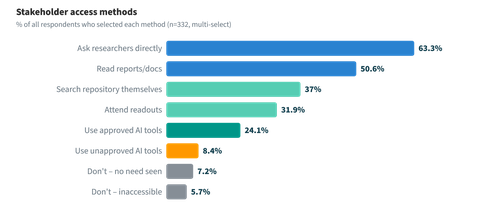
So researchers are the primary access point for the work they produce. Two-thirds of organizations route stakeholder questions through a human first.
Now look at what researchers tell us about their daily pain. The top pain point for researchers is "it takes too long to get from data to insights" (47%). The second is "stakeholders need faster answers than I can provide" (43%). Both are time-to-insight pressures, and both are about the analysis pipeline they sit at the center of.
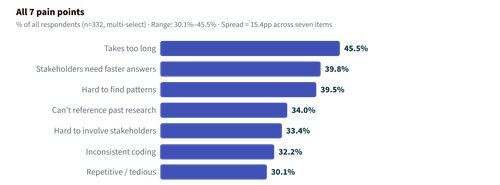
Put the two together, and you have a loop: Stakeholders default to asking researchers because that's the easiest way to get an answer. Researchers struggle to keep up with that demand. AI helps speed up parts of the workflow, but the bottleneck doesn’t really disappear, because the issue isn’t just how quickly insights are produced. It’s that existing insights are still hard for stakeholders to find, navigate, and confidently use on their own.
This is why the "stakeholders get insights faster" agreement number (59%) is lower than the "I analyze data faster" number (71%). AI is speeding up the researcher more than it's speeding up the system. The 12-point gap reflects exactly that.
There's a contradiction worth flagging. 81% of practitioners plan to increase their AI use. But the part of AI most relevant to closing this loop, AI that helps stakeholders self-serve from existing research, is also one of the least developed and least adopted. AI is being applied where researchers already work, not where the pressure on researchers actually comes from.
That gap between where AI is being applied and where the pressure actually comes from has an organizational parallel: adoption is running well ahead of governance.
91% of practitioners are using AI in their analysis work. 40% of them work in organizations with clear, followed policies on how AI should be used.
That gap is one of the more uncomfortable findings in this dataset, and it shows up across every company size.
The full breakdown is this: 40% have clear policies, 26% have informal guidelines, 14% have no policies and leave it to individual judgment, 10% have no policies but recognize they need them, and 8% aren't sure where their organization stands. Combined, just under 60% are either operating without formal governance or are uncertain about it.
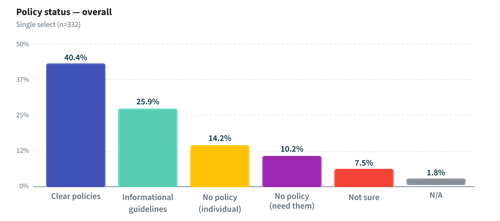
Company size moves the number, but not by as much as you'd expect. The largest organizations (10,000+ employees) have the highest clear-policy rate at 49%. The 201 to 5,000 employee bands sit at 43 to 45%. Smaller companies trail at around 33%. Even at the most policy-mature end of the sample, fewer than half of organizations have settled on how AI should be used in research work.
All of this matters because research data often includes highly sensitive information, including verbatim participant quotes, behavioral observations, and personally revealing experiences. When 73% of practitioners are using general-purpose LLMs (the highest of any tool category), and 8% of stakeholders are using unapproved AI tools to access research, the surface area for policy gaps is substantial.
A few open responses captured the consequence of this gap from the user side:
„For data protection reasons, the data cannot be evaluated or linked to the company's AI. Everything is decentralized.“
These respondents are working in environments where the rules have been set, often by clients or compliance teams, and AI use is constrained as a result. They're a reminder that the absence of a clear policy is also a friction problem. In well-governed environments, people know what they can use. In ungoverned environments, they tend to either over-use or under-use, depending on temperament.
The resistance data adds a useful second layer here. When asked which group within organizations is most resistant to AI in research, the most common answer was researchers themselves (36%). Legal and compliance came in at 21%. Research leadership at 13%. Designers and PMs at 10% each. Executive leadership at 8%.
It would be easy to read "researchers are the resistant group" as a blocker to adoption. We'd argue the opposite read fits the data better. Researchers are also the group:
Most critical of AI outputs
Most likely to validate outputs thoroughly
Least likely to trust outputs without review
Reporting the lowest satisfaction scores
Their skepticism is grounded in their experience of where AI breaks, not in unfamiliarity with it. In other words, the resistance is informed. The same researchers being flagged as "resistant" are the people whose pushback is keeping flawed outputs from reaching stakeholders. That doesn't mean their skepticism never gets in the way. But it’s rarely about rejecting AI entirely. More often, the same insistence on quality that slows the system down is what keeps flawed outputs from reaching decisions.
The governance and resistance data together point to a useful tension. Organizations are adopting AI faster than they're formalizing how to use it. The people most likely to slow down adoption are also the people most qualified to do so responsibly. The companies that get the most out of AI in the next 12 months will likely be the ones that close the policy gap without overriding researcher judgment in the process.
When asked what would most improve AI analysis tools, practitioners converged around three priorities:
Improved accuracy (61%)
Stronger understanding of research methodology and context (52%)
Greater transparency into how conclusions were generated (50%)
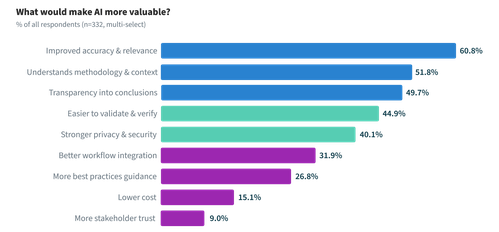
The common thread across all three is confidence. Practitioners are not simply asking AI to be smarter. They want outputs they can inspect, trace, and explain.
Interestingly, cost ranked relatively low as a concern. Only 15% selected lower cost as a major improvement area, while “more stakeholder trust” ranked lowest overall at 9%. The trust gap is being felt far more strongly by practitioners than by the stakeholders consuming the work.
Practitioners are filtering AI outputs on stakeholders' behalf because they're the ones who can tell when something is wrong.
Across the open responses, one theme appeared repeatedly: control.
Not necessarily control over the final answer, but control over:
The inputs
The reasoning process
The methodology
The contextual framing
How outputs are generated
Practitioners are asking AI to be more legible, not smarter.
Despite the frustrations surfaced throughout the survey, practitioners are not pulling back from AI in research analysis. 81% expect to increase their AI usage over the next year: 45% somewhat and 36% significantly. Only 0.6% expect their usage to decrease.
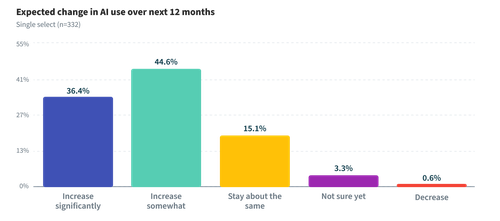
This is one of the most consensus-driven results in the entire survey. There's essentially no audience that thinks AI is going to play a smaller role in their research work over the next year.
The role differences in the "looking ahead" data are smaller than they were in the satisfaction data, and that's significant on its own.
Product Managers have the highest "increase significantly" rate at 45%, which fits their high satisfaction. But they also have the highest "stay the same" rate at 23%, which suggests they're already close to where they want to be. Researchers and designers, the two groups most critical of current AI quality, still report a roughly 33% "increase significantly" rate, with another 49% planning to increase somewhat. ReOps sit at 41% "significantly," and they're the only group with even one respondent saying they expect to decrease.
The most important finding in the looking-ahead data is the relationship between satisfaction and direction.
Researchers report a median satisfaction of 6. They distrust AI outputs. They validate everything. They are the most critical group in the survey. And 82% of them plan to increase their AI use.
The same is true at the company-size level. Large enterprise respondents have lower satisfaction (median 6) than smaller companies (median 7). They also have the highest "increase significantly" rate.
Low satisfaction is not translating into reluctance. The direction is settled. People are committed to AI in research analysis, even when their current experience of it is mixed.
That's the most honest read of where the field stands. Adoption isn't the question anymore. The question is what AI is going to be good for two years from now, and whether the gap between speed and quality closes, narrows, or widens.
Across 332 responses, the overall picture was remarkably consistent. Practitioners broadly agree on:
Where AI already creates value
Where it still struggles
What kinds of workflows feel productive
What would make AI more trustworthy
The reality emerging from the survey is more nuanced than either AI hype or AI skepticism alone.
AI is helping practitioners move faster through the mechanical parts of research analysis. That's not a small thing. Transcription, summarization, clustering, and surfacing a first-pass set of themes used to consume a meaningful share of every project. If those hours can move into synthesis and strategic work instead, that's a genuine improvement to the craft.
But speed alone isn't progress. The validation overhead in the data is a warning sign. If AI saves a researcher three hours on first-pass analysis but adds two hours of checking for hallucinations, missed quotes, and over-confident conclusions, the net win is much smaller than the marketing numbers suggest. And the loss of trust along the way has its own cost.
When practitioners told us what they wanted, they didn't mostly ask for smarter outputs. They asked for more transparent ones. Show me what context you used. Let me see your reasoning. Let me train you on my codebook. AI tooling for research should be inspectable by default, not by request. The researcher needs to be able to defend the work, and they can only do that if they can see how the work was done.
Researchers, Product Managers, Designers, and ReOps teams are not solving the same problems with AI. Product Managers want fast, confident summaries they can act on. Researchers want traceable, controllable analysis they can defend. Designers want access to past research. ReOps optimize for scale and operational efficiency.
That's worth naming the next time AI lands differently across your team. A PM finding AI "great" and a researcher finding it merely "okay" isn't a disagreement about the tool. It's two different jobs being done with the same tool, judged against different standards. Knowing that a gap exists makes the cross-functional conversation easier and harder to dismiss as researcher skepticism or foot-dragging.
The survey suggests the biggest remaining challenge is not raw analysis speed, but rather helping organizations reliably access and reuse existing research knowledge without routing every question back through a researcher.
Until research becomes easier to discover, navigate, and trust at scale, researchers will continue acting as the organizational bottleneck.
The most critical voices in the survey were also the most qualified ones. Their pushback is what's keeping flawed AI outputs out of stakeholder decks and product decisions. Building AI tools that override that judgment would be a step backwards. Building tools that amplify it is what good looks like.
The direction is clear. AI is becoming deeply embedded in research workflows. The remaining question is what kind of AI research teams will trust two years from now, and how much of today’s gap between speed and confidence can realistically be closed in that time.

Lena is the Head of Marketing at Condens, where she leverages her expertise in B2B and SaaS marketing. With a proven track record in crafting effective strategies for tech startups, Lena is passionate about optimizing processes and gaining insights into user behavior. She believes that understanding user pain points, needs, and preferences is crucial for successful marketing. At Condens, she is eager to lead marketing initiatives and contribute valuable insights to the UX research community.

Iva is the Senior Product Marketing Manager at Condens, where she focuses on positioning, messaging, and G2M. With eight years in B2B SaaS, she's developed a real appreciation for the messy, ambiguous early stages of building where there's no playbook yet and the work gets to shape itself. She's passionate about grounding marketing in real customer insight and translating that into work that resonates with the people it's meant to reach.
